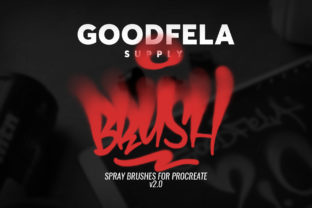
Evaluating Spray Brushes: A Deep Dive into the 8-Brush Set with Flare Variants
In the evolving landscape of digital art tools, the specific mechanics of how pigment is applied to a virtual canvas can define an artist's workflow. Among the myriad of options available, Spray Brushes have carved out a distinct niche, particularly for creators who require atmospheric depth, texture, and rapid coverage without the rigidity of standard airbrush tools. When evaluating a comprehensive set that includes eight primary brushes alongside their "flare" versions—totaling sixteen unique instruments—it becomes essential to understand not just what these tools do, but where they fit within a broader creative toolkit. This analysis aims to provide a balanced perspective on the utility, trade-offs, and ideal applications of such a specialized brush collection.
Defining the Core Mechanics of Spray Brushes
At their foundation, spray brushes simulate the behavior of aerosolized paint. Unlike hard-edged pencils or soft, blending-focused smudgers, these tools are designed to deposit color in a dispersed pattern. The distinction lies in the particle distribution; a well-engineered spray brush mimics the randomness of physical spray paint, creating gradients that feel organic rather than digitally perfect.
The specific set under consideration here offers a dual-layered approach. It provides eight core variations, each likely tuned to different viscosities, spread radii, and opacity levels. However, the inclusion of "flare" versions (denoted as x.1) adds a critical dimension to the set. In digital terminology, a "flare" often refers to an additive glow, a bloom effect, or a heightened saturation at the point of impact. By pairing a standard spray with a flare variant, the set allows artists to toggle between matte, realistic deposition and luminous, light-emitting applications without switching toolsets. This duality is significant for workflows that demand both structural shading and atmospheric lighting.
Comparative Analysis: Spray Brushes vs. Traditional Airbrushes
To truly evaluate the value of this 16-brush ecosystem, one must compare it against the industry standard: the generic digital airbrush. While both categories serve the purpose of smooth blending, their operational philosophies differ.
- Texture and Grain: Standard airbrushes often strive for absolute smoothness, which can sometimes result in a "plastic" look if overused. Spray Brushes, conversely, typically incorporate noise algorithms or grain textures that replicate the speckle of real-world cans. This makes them superior for concept art, environmental design, and any style requiring a tactile feel.
- Edge Control: Generic airbrushes usually offer a uniform falloff. The eight distinct brushes in this set likely vary in their edge hardness. Some may be designed for tight masking, while others are intended for wide, diffuse clouds. The flare versions further complicate this by introducing non-linear light falloff, which standard airbrushes rarely achieve without complex layer blending modes.
- Workflow Efficiency: Having the flare variants built-in eliminates the need to create duplicate layers set to "Screen" or "Overlay" modes manually. For professionals working under tight deadlines, this integration reduces click-count and keeps the focus on the artistic gesture rather than software management.
The Role of Flare Variants in Lighting Scenarios
The inclusion of the x.1 flare versions is perhaps the most compelling feature for lighting artists and illustrators. In traditional digital painting, creating a light source that feels intense often requires stacking multiple layers or using external glow filters. These methods can be destructive or computationally heavy.
With the flare-enabled spray brushes, the light interaction is baked into the stroke itself. This is particularly useful for:
- Sci-Fi and Fantasy Environments: Creating neon signs, engine exhausts, or magical auras where the light needs to bleed into the surrounding atmosphere immediately.
- Highlighting Volumetrics: When painting fog, dust, or smoke, the flare variant can simulate light catching particulate matter, adding depth that a flat spray cannot achieve.
- Rapid Prototyping: During the thumbnailing phase, an artist can establish mood and lighting direction simultaneously, rather than blocking in colors first and adding lights later.
Decision Factors: When to Choose This Set
Selecting the right toolset is rarely about finding the "best" option in a vacuum; it is about finding the best fit for a specific workflow. The 16-brush spray set is not a universal replacement for all painting tools, but it excels in specific contexts.
Ideal Use Cases:
If your primary work involves environmental concept art, matte painting, or stylized illustration that relies heavily on atmosphere, this set offers a distinct advantage. The ability to switch between a gritty, realistic spray and a glowing flare version allows for a dynamic range of expression within a single pass. Furthermore, artists who struggle with achieving natural-looking gradients will find the varied dispersion patterns of the eight core brushes helpful in breaking up monotony.
Potential Limitations:
However, there are scenarios where these brushes may not be the optimal choice. For hyper-realistic portrait work that requires subtle, invisible blending, the inherent grain or "spray" characteristic might be too aggressive. Similarly, for technical illustration or line-art heavy styles, the diffuse nature of spray brushes can lack the precision required for clean edges. Additionally, if an artist prefers to build up lighting effects through post-processing or layer styles for maximum control, the pre-baked flare effect might feel restrictive, limiting the ability to adjust the intensity of the glow after the stroke has been made.
Navigating the Trade-offs: Control vs. Speed
A central theme in evaluating Spray Brushes is the balance between procedural speed and manual control. The primary benefit of this 16-brush collection is speed. The preset variations allow for rapid iteration. An artist can test five different atmospheric conditions in minutes by cycling through the core and flare variants.
The trade-off, however, is a potential loss of granular control. Because the flare effect is intrinsic to the brush tip, adjusting its intensity mid-stroke is difficult without altering pressure sensitivity settings or flow. In contrast, a workflow that uses a standard soft brush on a separate glow layer offers infinite adjustability via opacity sliders and blending modes, albeit at the cost of more steps. Professionals must weigh whether the immediacy of the flare brush outweighs the flexibility of a layered approach.
Integration with Existing Workflows
For those considering adopting this set, integration is key. These brushes should not be viewed as a standalone solution but as a specialized module within a larger library. They complement hard-edge shaders and texture stamps effectively. A robust workflow might involve using the core spray brushes for base tonal mapping, the flare versions for initial light placement, and then refining details with sharper tools. This hybrid approach leverages the strengths of the spray mechanics while mitigating their limitations regarding precision.
It is also worth noting the learning curve associated with specialized tools. While the concept of "spray" is intuitive, mastering the nuance between the eight variations requires experimentation. Artists should dedicate time to testing how each brush interacts with different canvas resolutions and opacity settings. The x.1 flare versions, in particular, may behave differently depending on the background color, as additive light effects interact uniquely with dark versus light substrates.
Final Verdict on Utility and Fit
In the final analysis, the value of a brush set containing eight spray variations and their corresponding flare counterparts lies in its versatility for atmospheric creation. It addresses a common pain point in digital art: the disconnect between applying color and applying light. By merging these functions, the set streamlines the process of building mood and depth.
However, it is not a panacea. Artists whose work demands clinical precision or who prefer a strictly layered lighting workflow may find the built-in flare effects unnecessary or even obstructive. The decision to integrate these Spray Brushes should be driven by a desire for faster atmospheric rendering and a stylistic preference for textured, organic gradients. For concept artists, matte painters, and illustrators looking to enhance their environmental storytelling capabilities, this collection represents a thoughtful expansion of their digital arsenal, offering a pragmatic balance between realistic texture and stylized luminosity.
Ultimately, the most effective tool is the one that disappears into the workflow, allowing the artist's intent to remain the focal point. For many, this 16-brush system achieves that transparency, providing the right amount of chaos and light to bring digital canvases to life.