Choosing the Right Industrial Vector Brushes for Technical and Creative Design Workflows
In the realm of digital illustration and technical design, the efficiency of your workflow often hinges on the quality and specificity of your tools. For designers working within mechanical, architectural, or steampunk aesthetics, Industrial Vector Brushes have become an indispensable asset. Unlike standard artistic brushes that mimic organic media like watercolor or charcoal, these specialized tools are engineered to replicate the precision, repetition, and geometric rigidity found in machinery and infrastructure. When evaluating resources for a project, understanding the distinct capabilities of these brushes compared to manual drawing methods or generic pattern libraries is crucial for making an informed decision.
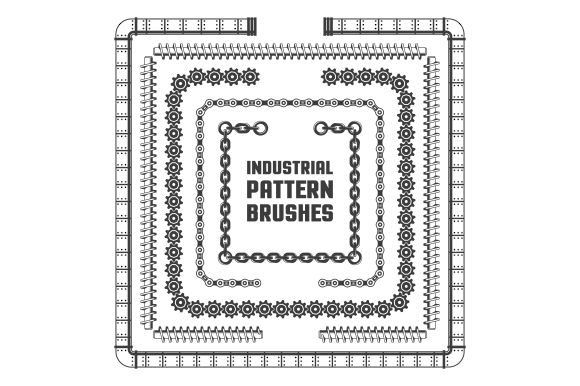
The core value proposition of industrial vector brushes lies in their ability to generate complex, repetitive mechanical elements instantly while maintaining mathematical precision. A typical collection included in a brush panel might feature a diverse array of tools, ranging from a detailed chain brush that links seamlessly around curves to a robust pipe brush capable of creating fluid hydraulic systems with consistent wall thickness. Furthermore, a high-quality gear brush allows for the rapid placement of cogwheels and sprockets without the need to draw each tooth individually. These tools are not merely shortcuts; they are structural aids that ensure consistency across a design, a factor that is often difficult to achieve when drawing freehand.
Evaluating Precision and Editability in Vector Formats
When comparing different resource options, the file format plays a pivotal role in determining long-term utility. The industry standard for professional work remains the Vector EPS10 format. This specification ensures that the brushes are resolution-independent, meaning designs can be scaled from a small icon to a large-format billboard without any loss of clarity or pixelation. More importantly, an "easy editable file" structure implies that the underlying paths are clean, organized, and accessible.
For a designer, this editability is a significant trade-off consideration. Some lower-quality brush sets may group elements excessively or expand appearances prematurely, locking the user into a specific look. In contrast, a well-constructed industrial brush set preserves the integrity of individual anchor points. For instance, if you use a pipe brush to create a conduit system, you should be able to adjust the stroke weight to change the pipe diameter globally or modify specific segments without breaking the pattern. This level of control distinguishes professional-grade assets from decorative clipart, allowing for genuine customization rather than simple placement.
Comparing Specialized Brushes Against Manual Drafting
A common alternative to using pre-made industrial brushes is manual drafting using basic shape tools and pathfinders. While this approach offers absolute freedom, it is time-intensive and prone to human error regarding alignment and spacing. Consider the task of creating a realistic chain. Drawing this manually requires calculating the link length, ensuring perfect overlap, and rotating each segment to follow a path smoothly. A dedicated chain brush automates this logic, distributing the link artwork along a path with precise rotation and spacing settings.
However, manual drafting does have its place. If a project requires a highly unique, non-standard mechanical component that does not exist in any library, building it from scratch is necessary. The decision factor here is frequency versus uniqueness. If your design relies on standard industrial elements like bolts, rivets, gears, or piping, leveraging a brush panel is objectively more efficient. The time saved on repetitive tasks can be reallocated to composition, lighting, and conceptual development. Conversely, if the project demands a one-off, fantastical machine part that defies real-world physics, the constraints of a pre-made brush might limit creativity, making manual construction the better choice.
Application Scenarios: Where Industrial Brushes Excel
The versatility of industrial vector brushes extends beyond obvious mechanical illustrations. They are increasingly utilized in branding, packaging, and UI design to convey themes of durability, engineering, and reliability. For example, a logistics company might use a subtle pipe brush pattern as a background texture to suggest connectivity and flow. Similarly, a tech startup focusing on hardware might incorporate a gear brush motif to symbolize internal workings and precision.
In the context of game asset creation and concept art, these brushes serve as rapid prototyping tools. Artists can block out the silhouette of a vehicle or a factory environment in minutes, establishing the scale and mechanical language of the scene before committing to detailed rendering. The ability to toggle between different brush types within the same panel allows for quick iteration. One moment you are sketching a tread system, and the next you are adding riveted plating. This fluidity supports a dynamic creative process that static image libraries cannot match.
Limitations and Potential Pitfalls
Despite their advantages, industrial vector brushes are not a panacea. A primary limitation is the risk of visual homogeneity. Because these brushes rely on repeating patterns, overuse can lead to designs that feel generic or "stamped." When multiple designers utilize the same popular EPS10 files without modification, the resulting artwork can lack a unique voice. To mitigate this, it is essential to treat the brush output as a base layer rather than a final product.
Effective usage involves modifying the generated paths. This might mean altering the color palette, combining different brushes to create hybrid textures, or manually adjusting anchor points to introduce wear and tear. A pristine, mathematically perfect gear looks artificial; adding slight irregularities or integrating it with hand-drawn grunge elements creates a more believable aesthetic. Therefore, the skill of the user remains paramount. The tool provides the geometry, but the artist provides the soul.
Another consideration is software compatibility. While EPS10 is a robust standard, some advanced brush dynamics (such as pressure-sensitive scaling or tilt-based rotation) may behave differently depending on the vector software version being used. Users must verify that their specific workflow supports the features advertised in the brush set. A brush that works flawlessly in the latest version of a leading design suite might revert to a static pattern in older iterations or alternative open-source programs.
Making the Final Decision: Fit and Functionality
Ultimately, choosing to integrate industrial vector brushes into your toolkit depends on your specific project requirements and workflow preferences. If your work frequently involves technical illustration, schematic diagrams, or stylized mechanical art, the investment in a high-quality, editable set is logical. The inclusion of specific tools like chain, pipe, and gear brushes covers a broad spectrum of industrial needs, reducing the friction between idea and execution.
However, if your design style is strictly organic, hand-lettered, or abstract, these tools may offer little value. It is also worth considering the learning curve associated with mastering brush settings. Understanding how to manipulate spacing, rotation, and size variation within the brush panel takes practice. Beginners might initially find the results rigid until they learn to tweak the parameters effectively.
In conclusion, industrial vector brushes represent a powerful intersection of artistic expression and engineering precision. They offer a pragmatic solution for creating complex mechanical visuals with speed and accuracy. By selecting a versatile, high-resolution EPS10 collection, designers gain the flexibility to scale and edit their work indefinitely. Yet, the true potential of these tools is unlocked only when the designer applies critical judgment, modifying and combining elements to avoid cliché and ensure the final output aligns perfectly with the project's unique vision. Whether you are drafting a blueprint or illustrating a futuristic cityscape, these brushes serve as a foundational element, bridging the gap between conceptual roughs and polished, production-ready assets.